


Black Sea grain exports deal must enable full agricultural value chain, ICC says
ICC has issued a statement following the signature of a deal to allow the resumption of grain exports via the Black Sea.
ICC, UN & partners
Speaking at a high-level gathering of nearly 50 government and international organisation representatives at the United Nations, ICC Secretary General John W.H. Denton AO warned that disruption to critical trade routes is placing already fragile food systems under growing strain.

Addressing participants of the high level side event of the United Nations General Assembly – including the EU High Representative for Foreign Affairs and Security Policy, foreign ministers and other senior officials from more than 25 countries, alongside UN humanitarian leaders – Mr Denton underscored the power of trade as a humanitarian tool when backed by international cooperation, pointing to ICC’s role in supporting the 2022 Black Sea Grain Initiative which enabled nearly 33 million tonnes of grain and food products to reach global markets.
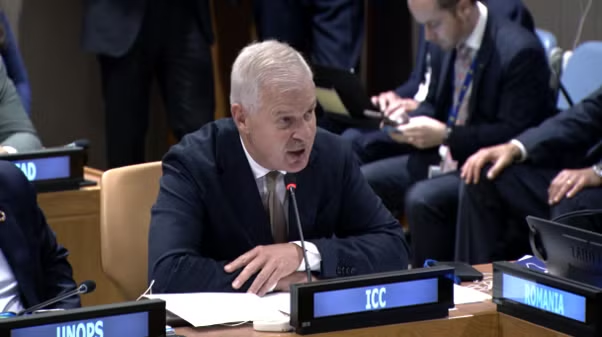
The full address is as follows:
Excellencies and distinguished delegates,
Recent developments in the black sea underscore a fundamental reality: when critical trade routes are disrupted, the consequences are felt far beyond the immediate conflict zone.
They are felt by a farmer in East Africa waiting for fertiliser, by a family facing rising food prices, and by humanitarian agencies struggling to secure supplies for the world’s most vulnerable populations.
Today, industry is deeply concerned by a convergence of food security risks.
The blockade of key black sea ports, continued disruptions affecting the Strait of Hormuz, and the potential return of El Niño conditions all threaten to place additional strain on already fragile food systems.
The full effects may not be visible today. In fact, they are likely to emerge only in the coming months through reduced harvests, tighter supplies and higher prices. But that is precisely why there is a strong case for early, coordinated preventive action now.
In this context, ICC strongly welcomes this effort to focus attention on the Black Sea.
At ICC, we have seen the importance of timely action before. In 2022, as a member of the UN Global Crisis Response Group, we helped support the Black Sea Grain initiative, bringing the practical perspective of businesses operating across agricultural supply chains, shipping networks and commodity markets.
The initiative demonstrated what international cooperation can achieve. Nearly 33 million tonnes of grain and food products were exported through a humanitarian maritime corridor, helping to stabilise markets, reduce food prices and support critical humanitarian operations around the world.
But perhaps its most important achievement was restoring confidence. It showed that trade can be a powerful humanitarian tool when political cooperation exists.
Today, our network in Ukraine is sending a clear message: there is an urgent need to get grain moving again before storage capacity is reached in the coming six weeks. Delays will have consequences not only for Ukraine, but for global food availability and affordability.
ICC therefore stands ready to work with international partners to ensure that any solution to reopen the Black Sea is commercially workable, operationally practical, and capable of supporting the scale of exports required in the months ahead.
The lesson from the Black Sea experience is clear: preventing a food crisis is far easier than responding to one.
The time to act is before the impacts are visible, not after they are felt.
Thank you.
ICC has issued a statement following the signature of a deal to allow the resumption of grain exports via the Black Sea.

As global fragmentation and power-based approaches increase uncertainty for businesses, ICC Secretary General John W.H. Denton AO joins Vrinda Tiwari, Asia-Pacific Programme Officer at the International Energy Agency (IEA), to discuss the evolving role of business in an increasingly complex global environment. From WTO reform to the Black Sea and the Strait of Hormuz, they make the case for why business must move from observer to active participant in shaping the future of multilateralism.

ICC is supporting a new confidence-building mechanism developed by the UN Secretary-General’s Strait of Hormuz Task Force to facilitate safe, orderly and predictable maritime transit through one of the world’s most critical trade routes.
