Home » News and publications » ICC highlights trade and finance priorities at IMF-World Bank Annual Meetings
Trade finance
ICC highlights trade and finance priorities at IMF-World Bank Annual Meetings
16 October 2026
ICC Secretary General John W.H. Denton AO called for greater international cooperation to strengthen global economic resilience, safeguard food security and unlock financing opportunities for small businesses during the IMF-World Bank Annual Meetings in Bangkok.
Share this:
Representing more than 45 million businesses in over 170 countries, ICC highlighted the need to address barriers to trade and finance, particularly for micro-, small- and medium-sized enterprises (MSMEs) and businesses in developing and emerging economies.
Unlocking finance and digital opportunities for small businesses
Speaking at a panel discussion on MSME financing on 13 October, Mr Denton called on governments to accelerate the adoption of legal frameworks to facilitate cross-border digital trade and improve access to finance for smaller businesses.
The session featured a keynote address by World Bank Group President and former ICC Chair Ajay Banga, who highlighted how data and digitalisation can unlock opportunities for businesses traditionally excluded from formal financial systems.
Building on these remarks, Mr Denton warned against the emergence of “digital islands”, where fragmented regulations and a lack of interoperability prevent smaller businesses from benefiting fully from digital trade.
“Digital sovereignty should not mean closing your borders. Digital sovereignty should be about making choices,”
He urged policymakers to advance mutual recognition and harmonisation of digital trade frameworks, enabling MSMEs to trade across borders without navigating multiple sets of regulations.
John Denton, Secretary General, International Chamber of Commerce
Highlighting ICC’s work to facilitate digital trade, Mr Denton called for wider implementation of the UNCITRAL Model Law on Electronic Transferable Records (MLETR), which provides a legal framework for recognising electronic trade documents, including electronic bills of lading.
He also stressed the need to modernise regulatory approaches to SME financing, pointing to data from the 2025 ICC Global Trade Intelligence Report – formerly known as the ICC Trade Register – showing a default rate of approximately 0.24%, while existing risk-weighting frameworks can make it uneconomic for financial institutions to serve smaller businesses.
Mr Denton called on policymakers to make better use of available trade finance data to inform regulatory decisions and help close the financing gap for MSMEs.
Safeguarding global food security amid trade disruptions
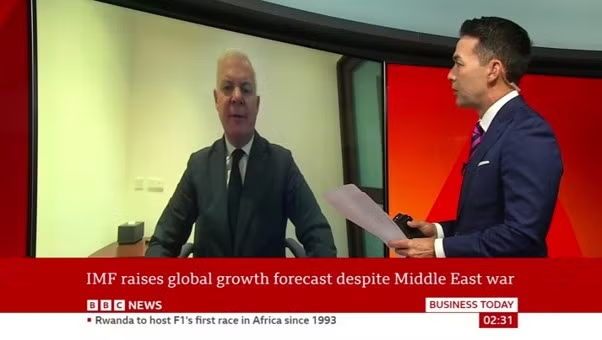
Speaking in a BBC News interview from Bangkok, Mr Denton warned of growing risks to global food security from disruptions to critical shipping routes, calling for urgent action to safeguard fertiliser supplies and avert a humanitarian crisis.
While acknowledging the resilience of the global economy despite successive shocks, he cautioned that mounting pressures on trade and supply chains risk undermining growth, particularly in developing and emerging economies.
Mr Denton underscored disruption of fertiliser shipments through the Strait of Hormuz as a key concern warning that fertiliser flows had fallen by approximately 30%, potentially contributing to food price increases of up to 80% in some markets.
“If we could get three to five ships a day with fertiliser through, we can avert what is a looming disaster,”
John Denton, Secretary General, International Chamber of Commerce
Mr Denton also highlighted ICC’s work through the UN Secretary-General’s task force on the Strait of Hormuz to facilitate the movement of essential fertiliser shipments and mitigate the impact of trade disruptions on global food security.
He called on the parties concerned to enable the passage of fertiliser shipments through the Strait, stressing that maintaining access to these essential supplies is critical to preventing a wider humanitarian crisis.
The initiative builds on ICC’s ongoing work with the United Nations and international partners to strengthen global food security and mitigate the impact of trade disruptions on vulnerable populations.
Mr Denton also pointed to growing risks at other strategic shipping routes, including the Bab el-Mandeb Strait, alongside attacks on infrastructure in the Black Sea that threaten agricultural exports from Ukraine, a major supplier of food to global markets.
Emphasising the need for greater international coordination to strengthen the resilience of critical trade routes and protect essential goods and services, Mr Denton said:
“It’s really important that we get focused on how we build resilience around those chokepoints and how do we actually ensure essential elements like food are not prejudiced.”
Turning to Southeast Asia, Mr Denton noted that businesses were seeking alternative sources of energy and fertiliser, adding to costs and supply chain pressures. At the same time, he welcomed strong export performance across ASEAN economies, including Vietnam, Thailand and Malaysia, and underscored the importance of deeper regional economic integration to support resilience and growth.
Through engagement at the IMF-World Bank Annual Meetings, ICC continues to call for practical measures to keep trade flowing, improve access to finance and create greater economic opportunities for businesses worldwide.
Concluding the week, Mr Denton participated in a World Bank Group roundtable on trade and supply chain finance, facilitated by World Bank Director Denis Medvedev and featuring IFC Managing Director Makhtar Diop and WTO Director-General Ngozi Okonjo-Iweala. He highlighted ICC’s work to expand access to supply chain finance, calling for better use of trade finance data to inform regulation, greater engagement with smaller businesses through ICC’s chamber network and stronger digital skills to help SMEs access financing.
The ICC Global Trade Intelligence Report is the leading industry benchmark and analytical resource for trade finance, providing banks, regulators and market participants with robust data and insights on the performance and resilience of trade finance products.
ICC is supporting a new confidence-building mechanism developed by the UN Secretary-General’s Strait of Hormuz Task Force to facilitate safe, orderly and predictable maritime transit through one of the world’s most critical trade routes.
With the closure of the Strait of Hormuz, Svein Tore Holsether, President and CEO of the fertiliser-company, Yara International, joins ICC's Andrew Wilson to detail what fertiliser supply disruptions mean for food production and food security worldwide. Svein Tore explains the risk of crop failures in the world's most vulnerable regions, what governments can do to mitigate the damage and why this crisis should strengthen rather than weaken the case for climate action.
Respecting your privacy
We use necessary cookies to make our site work. We'd also like to set optional cookies to optimize site functionality and to give you the most relevant experience. We won't set optional cookies unless you enable them. Using this tool will set a cookie on your device to remember your preferences.
Functional
Always active
The technical storage or access is strictly necessary for the legitimate purpose of enabling the use of a specific service explicitly requested by the subscriber or user, or for the sole purpose of carrying out the transmission of a communication over an electronic communications network.
Preferences
The technical storage or access is necessary for the legitimate purpose of storing preferences that are not requested by the subscriber or user.
Statistics
Always active
The technical storage or access that is used exclusively for statistical purposes.The technical storage or access that is used exclusively for anonymous statistical purposes. Without a subpoena, voluntary compliance on the part of your Internet Service Provider, or additional records from a third party, information stored or retrieved for this purpose alone cannot usually be used to identify you.
Marketing
The technical storage or access is required to create user profiles to send advertising, or to track the user on a website or across several websites for similar marketing purposes.