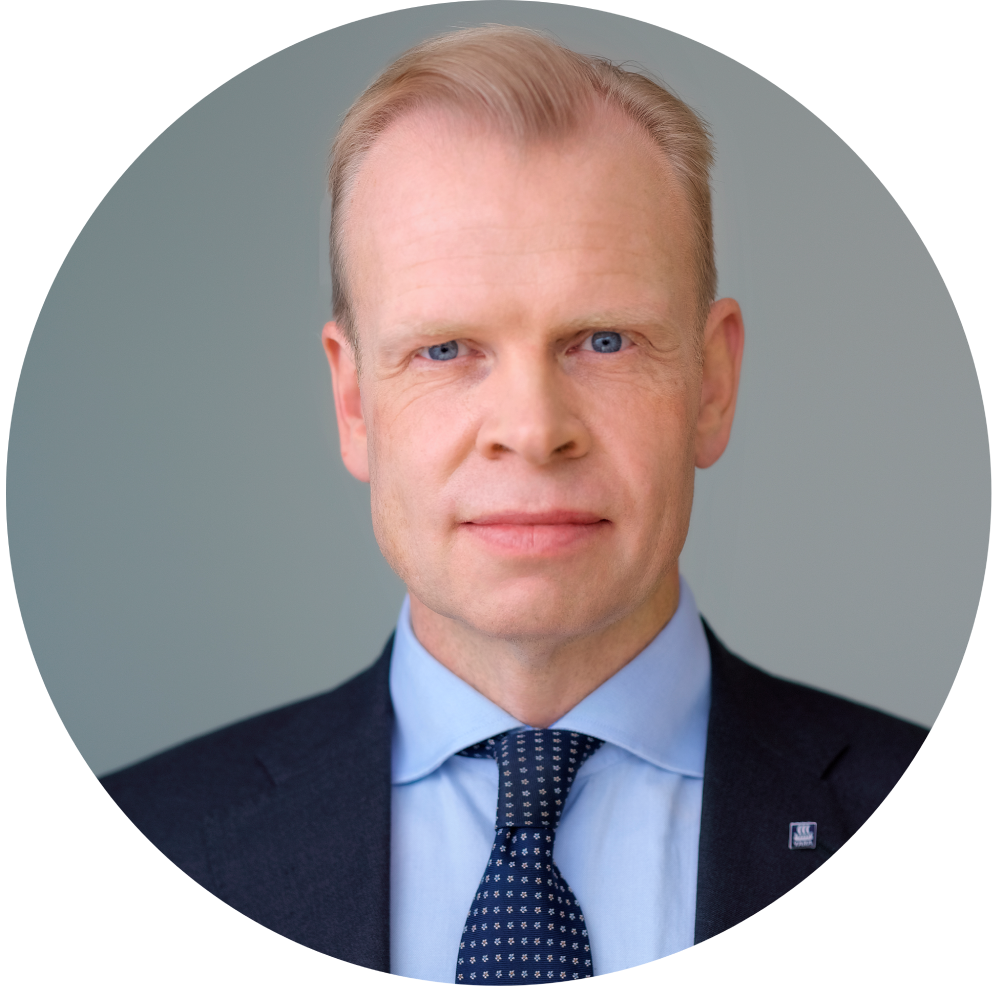
Andrew Wilson (00:02)
Hello and welcome to Trading Thoughts, a podcast from the International Chamber of Commerce. I’m Andrew Wilson from the policy team at ICC Headquarters in Paris. And today’s episode is the first in a series looking beyond the headlines of the Iran conflict and specifically the closure of the Strait of Hormuz. While the media lens in recent weeks has understandably been fixed on the impact of the conflict on oil, gas, and energy prices, there is a much broader picture emerging, we think, in terms of the impact of the Hormuz use closure on trade and supply chains, which could have potentially far reaching economic and indeed societal effects. And nowhere is that risk more acute than in relation to the global supply of fertilizers, on which a huge proportion of global crop production currently relies. So today we’re delighted and indeed honored to be joined by Svein Tore Holsether here, president and CEO of Yara International, one of the world’s leading fertilizer and crop nutrition companies. Svein Tore, huge thanks for taking time out of your very busy schedule to join the ICC podcast.
Tonje Næss (01:08)
Well, great to be with you, Andrew.
Andrew Wilson (01:11)
So just to really start with the context, and as I said, this issue of fertilizer supply is something that potentially has been a little bit obscured by the focus of the media on energy price inflation. The Strait of Hormuz has now been closed for circa 90 days, I think just above 90 days, in fact, as of the day of recording this podcast. Could you explain to our listeners perhaps on why that matters to the global supply of agricultural nutrients and what you’ve seen happening in the global fertilizer market over the last three months or so?
Tonje Næss (01:47)
Sure, indeed it is a very serious situation in the Middle East and has significant humanitarian and geopolitical consequences in the region, but it also shows how global the food trade is now and how this is spilling straight into global movement of fertilizers. And for obvious reason, as you mentioned, the main focus is on oil, gas, energy. But at the end of the day, why do we eat food? It’s about getting energy for our human bodies as well. And in order to produce food, we need to use fertilizer in order to do that at scale. And fertilizer is not just any other commodity. In fact, half of the world’s food is a direct result of fertilizers. The principle here is that when the farmers remove a crop from their field, they also remove nutrients and those need to be replaced and that is fertilizers. And when you have disturbances to the supply of that, that has major consequences. And the Strait of Hormuz is actually the most important shipping lane for urea fertilizer in the world. About one third of exported urea goes through the Strait of Hormuz. And it’s a hit on many areas right now because we use a lot of energy in order to produce fertilizer. So it’s an energy hit that we already touched on. It’s the inability to ship fertilizer through the Strait of Hormuz.
And then third, it’s for some of the production plants, also the inability to produce fertilizer right now, either because of damage, because of attacks, or simply just running out of inventory. And this comes at a rather demanding time for farmers as well. This started at the end of February in many parts of the world. We’re in prime application season so we’ve seen the first impact and but it has a much longer impact as well so even with peace today this would still take a long time to sort out.
Andrew Wilson (04:25)
And just on the market effects, so what have you seen in terms of the cost or affordability of fertilizers, particularly from a kind of farmer’s perspective?
Tonje Næss (04:39)
Yeah, and this is an additional complexity and very demanding for farmers and slightly different to other crises that have hit the farmers because now they see big increases in many of the input costs, whether that is diesel to the tractor, to chemicals, but also to fertilizers. So their production costs have increased.
But it’s not coming at the same time as crop prices are increases. In fact, crop prices have been flat-ish or some small increases, but now we’ve seen in recent weeks that there has been a decrease again. So farmer profitability, their margins are really impacted by this. And they were not particularly strong to begin with many farmers across the world were struggling even before this crisis. Now they get even higher input costs while the crop prices haven’t moved. And the risk in that is that they simply can’t afford to buy the fertilizer that they should use agronomically in order to optimize the yields and that would have longer term consequences and not an immediate consequence on crop yield, but that.
If you don’t replace the nutrients, plants will just as us humans, if we don’t get the nutrients that we need, we would suffer from that with our health. And if we don’t get enough, we will not be able to survive. And it’s the same thing for crops as well. that’s my longer term worry that the decisions on fertilizer application are being taken now, but the crop impact will come at a much later stage. It is really, really a demanding time for farmers. And I met many of them. Several are delaying their purchases as much as they can in the hope that things will normalize. again, we’re risking other situation where there will be more demand than supply. So a lot of uncertainty for farmers right now.
Andrew Wilson (06:57)
So Svein Tore, so if if the stress on farms persists, so if fertilizers remain potentially unaffordable or inaccessible potentially in some regions, Do you have a sense of what the impact could be on future crop yields? When would that manifest itself? ⁓ basically are we looking at a potential global food security crisis down the track at some point?
Tonje Næss (07:24)
The short answer is that yes, we really do risk another food crisis and there are many people already at the brink of starvation. we’re challenging starting point ⁓ already, but how this will hit depends a lot on where in the world you are, your ability to afford your ability to get the support from governments and NGOs as well, and on the soil health to begin with. If you have a very good balance in your soil of nutrients, reducing fertilizer consumption somewhat will only have a limited impact on yields. And that goes for a number of farms in close proximity to where our head office is in Europe. So for European farmers, they can reduce somewhat without significant yield impact. They have a more flat yield curve because they’re fertilizing in an optimal way. In other parts of the world, you have a very steep yield curve, meaning that there’s already an under application of fertilizer. So the plants aren’t getting all the nutrition needed to begin with. And then you would have much more severe impact as a result of that. So risk here again that it is the most vulnerable parts of the world and the most vulnerable people that will pay the highest price again. And then it also depends on what kinds of crops we’re talking about. But there are long-term studies that show for certain crops that if you are unable to supply nitrogen fertilizer out in the field, your yield could drop as much as 50 % in the first harvest. So that’s what we’re talking about here for some farmers in some parts of the world and over time. And I’ve seen this in many parts of the world and in particular in Africa, if you’re not able to maintain the healthy soil you degrade first the ability to create healthy crops, lower yields over time, and then over long-term horizon, you simply can’t grow anything. That says a lot about the urgency of this and also which parts of the world that will be hardest hit as a result of fertilizer shortage or simply in affordability as it is right now.
Andrew Wilson (10:08)
So hence, the risk of a humanitarian crisis in developing economies is is clearly very acute, albeit be it several months into the future. As you know, and as some of our listeners will know, we’ve been working with several UN agencies in recent weeks on a potential mechanism to allow for an early reopening of the Strait to fertilizer flows and also for related inputs, so ammonia, sulfur, etc. There’s obviously the ongoing peace talks between the US and Iran, which could allow for a broader reopening or at least some kind of phased reopening of the strait. But if supply remains disrupted in some way or if affordability continues to be an issue for for farmers, do you have a sense of what governments can do to mitigate the impacts that you were you were describing on crop yields?
Tonje Næss (11:03)
Well, for every day that passes now with the situation as it is, and with the lack of availability of fertilizer produced, and that normally would go through the Strait of Hormuz, we’re talking about billions of lost meals every week and that compounds. And it’s the developing part of the the world that will suffer the most, but it’s also message to all parts of the world, including the more wealthy countries as well to produce as much food as possible, even if you’re not facing a shortage in your own country or region.
I’ve said this in Europe earlier as well, there won’t be a food shortage in Europe because we have governments that have a balance sheet that can deal with this. But who are we then buying the food away from in a global auction of food? And that’s why it’s important that we think across all parts of the world. But there are areas where it’s very impactful now that institutions step in and support and that we’re establishing mechanisms to deal with this. And here it’s important that we don’t take short-term measures now that will come at a long-term cost. So it’s about targeting the support in a smarter way, ensuring that the every nutrient counts, it’s about precision farming, replacing the right nutrients in the field of the farmer. And I see that way too often that subsidy schemes are very much focused on tons of fertilizer, rather than replacing the nutrients that are needed. And in some cases, you know, adding, if you’re adding the wrong fertilizer, you’re doing more harm than, than good. So it’s about the targeted subsidies to ensure the right soil health that we invest in knowledge and training and make that available. And we’re doing that through Yara as well that we’re making tools available utilizing our agronomic competence to help farmers to replace the right nutrients in the field to both grow better crops, but also to do it in a more sustainable way. I think it’s important that any support works with the market and not against it. And with that, mean, build on private distribution, build on private storage, support last mile delivery instead of overcrowding it because I’ve also seen too many of these as well with very good intentions supporting in the short term. But if you then destroy the businesses that are actually doing it on an ongoing basis, that short term help, if that drives them out of business, okay, what comes next then. So that’s alo important. Then, and I partly touched on it, it’s the focus on efficiency, moving away from volume, ensuring that we have balanced nutrition also for plants and how important soil health is. And that has a dual impact, it’s both on food security and yields now, but also the ability to be resilient to climate change and extreme weather.
Andrew Wilson (14:46)
Just to go back to the whole news situation specifically, if there was a reopening tomorrow or next week or whenever, how quickly would you expect, to the greatest extent you can predict, the market to start normalizing?
Tonje Næss (15:04)
That’s a very, very difficult answer to give you. There are so many variables here and so much uncertainty. How is it reopened? Is it open in a way that shipping companies dare to send ships back into the Strait of Hormuz? One thing is moving what is stuck now out, but how do you create the certainty that you bring new ships in there? How does this spill into the energy markets as well? Because it’s not only about the fertilizer produced in that region, but also the energy cost to produce in other parts of the world, including Europe, including India, and many other countries that are sourcing energy in order to produce fertilizer. And then have a huge variable that we really can’t do anything with and that’s weather. How is weather going to be? How are the crop yields going to be? There’s talk about El Nino again, how will that impact? are so many variables. So I think it’s important that we focus on what is it that we can do something about and that is ensuring that we grow as much and as resilient as we can right now.
Andrew Wilson (16:30)
Understood. On that issue of resilience, I think one thing that has struck us in recent weeks from the work we’ve been doing with the UN is how similar some of the discussions we’re having with governments and international organizations are to what we saw during Russia-Ukraine, and indeed to an extent during the COVID-19 pandemic, when there was a sense that supply chains were too geographically concentrated or not sufficiently resilient. Coming out of this situation and the potential humanitarian impacts you described earlier, do you think there is a need for some kind of longer-term thinking on the resilience of food and fertilizer markets globally, potentially structural reforms?
Tonje Næss (17:17)
Absolutely. And I fully agree that, you know, we’ve seen this now a number of times and I’m just wondering how many alarms and how many times do we need to experience this before we do something to fundamentally improve the whole food system. And at same time, we have to acknowledge that the global food system over the last decade has really done a tremendous
job at producing more food to feed a growing population. So it’s in many ways a success in that sense, but it has also come at a cost. One is the environmental impact of food production. About 30 % of global greenhouse gas emissions come from the food system. And then it’s the how fragile it is to geopolitical conflict, to supply chain issues that we’ve experienced now. So that has to be the strong reminder now that we’ve created a more robust food system in the future, one that is both able to continue to feed a growing population that is more robust against shocks and one that also takes into consideration the environmental impact. And I’m saying that for several reasons, there are very few occupations that are more impacted by climate change than farmers are. I mean, they work out for the most part out in nature with all the variations from that. They feel droughts and floods and heat waves and cold spells every year now. So we need to deal with that as well. But we need to put science to the use. And here I am quite optimistic on what is happening across the world now. Look at what the AI is doing now in terms of processing information and making that available and to bring more science and data into decision making, simplifying the life of farmers for sure, ensuring that we do crop nutrition and farming the right way that we’re optimizing that as well. But also in terms of policy, to help policymakers, how do they create the best systems in order to incentivize the right practices as well? And what I’m seeing now, and I’ve been a lot out in the fields in the last , well for my entire 10 years here at the Yara, but in particular now in the last few months, how fast technology now can help to shape that. I’m talking about the sensor technology using satellite imagery to read the nutrition in the fields of the farmer, applying that in the right way. Hyperlocal weather understanding input cost versus crop prices, optimizing all of that and with focus on soil health. Technology will be a huge enabler and we are now in the fourth agricultural revolution and that will be driven by and it is driven by technology but I see that picking up in a tremendous pace right now so more to come in that area.
Andrew Wilson (21:02)
I have to say it’s very nice to hear a note of optimism amongst what is a rather sort of gloomy short term picture in terms of the impacts of the Iran crisis.
Just a final question. I just want to pick up on something you mentioned a few times, which is climate change. I think one thing we’ve been particularly struck by in recent weeks, particularly our engagements in Europe with business groups, but also with political figures as well, is the sense that the energy price inflation we’ve seen as a result of the closure of Hormuz is really kind of triggering a call to dial back on climate action, a sense that we should either take our foot off the accelerator, particularly in Europe, or dismantle existing structures such as the EU ETS, for instance. As someone who has been a pretty consistent leader and advocate for ambitious climate action, where do you stand on that? Is this the right moment to be dialing back or should we be thinking about this in in different terms?
Tonje Næss (22:10)
I believe we have to do two things at the same time now. Of course, dealing with the ongoing crisis. It’s not easy to be a politician these days, either balancing all the budgets and so on. I can understand the temptation to dial back on climate action. I think that would be a huge mistake because that’s just pushing that crisis and shock in front of us. And the longer we take to deal with the climate crisis, the bigger the impact will be. And potentially we pass through these tipping points where it’s irreversible as well. And that’s a challenge to our generation as well. We’re the first generation to really experience and feel the impact of climate change. And we’re the last generation where it’s only on our will to do something about it that prevents us from doing it. That’s a luxury that future generations do not have. If we don’t deal with that right now, we’re delegating that to future generations and they might not even be in a position where they can deal with that in an effective way. Then it is important that we do this in a way that we work through the whole value chain. It’s a cooperation between business and governments as well, because there has to be an enabling environment for it. And from the business side, it needs to be profitable as well. And I’m saying that not to be selfish here, in order, know, every company can do some showcase projects and create some PowerPoint slides on nice initiatives. But in order to scale, it has to be profitable as well. I say that there’s no green transition with red numbers and that also goes for farmers. We need to have incentives to support farmers. So it makes sense for them as well. And it’s not like we’re not paying the cost right now. It’s just being picked up in order parts of the value chain or being impacted by extreme weather and insurance claims and all of that. But we need to manage to do both at the same time and that’s a commitment from us in the business community. We’re proud in Yara that we set a very ambitious target back in and perhaps at the peak of enthusiasm around the peak and enthusiasm around the ESG and emission reduction, but we hit that target in 2025. And now we’re doing the hard to bait part. We’re doing the largest industrial decarbonization product with the carbon capture and storage in Netherlands this year. were producing that’s 800,000 tons of CO2 removed every year for the next 15 years. We’re doing green hydrogen. We’re doing precision farming. So we’re doing a lot, but at the end of the day, if farmers are not being incentivized. If there’s no framework driving communities towards lower carbon footprint, this is not going to happen at scale. So I think it would be a massive mistake if we are now so overwhelmed by today’s challenges that we don’t do what is right for the next five, 10, 20 years.
Andrew Wilson (25:42)
That’s a very clear and compelling message, and I think one that that we as ICC share with you and entirely. And I think one of the very interesting thing that’s really come through this whole discussion is the need for smart, focused, effective policymaking in response to the totality of challenges the world is facing. Svein Tore, I think we’re at time for this particular episode. Huge thanks for joining us and for sharing your perspectives on the stresses and strains facing the global agricultural market. We look forward to continuing our collaboration with you and colleagues at Yara. And many thanks to our listeners for joining this edition of ICC’s Trading Thoughts Podcast. Thank you.
Tonje Næss (26:29)
Well, thank you, Andrew. It’s always inspiring to talk with you. Thank you again.