Home » News and publications » ICC delivers Business and Industry opening statement at Bonn Climate Change Conference
ICC, UN & partners
ICC delivers Business and Industry opening statement at Bonn Climate Change Conference
9 June 2026
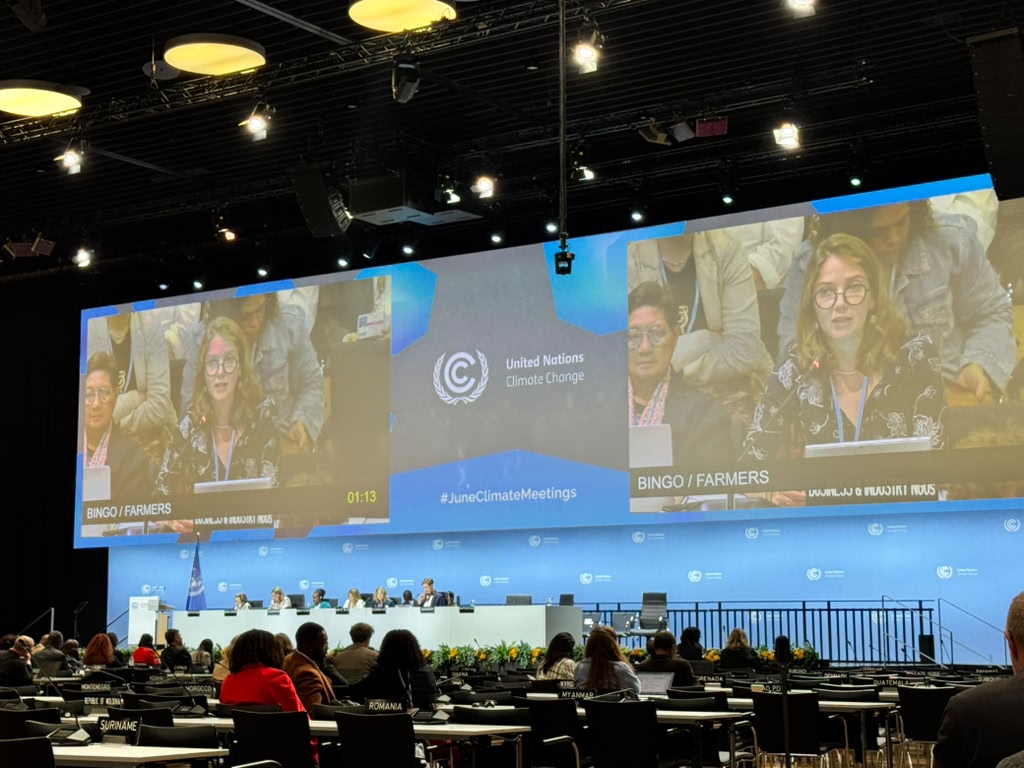
The International Chamber of Commerce (ICC), on behalf of the UNFCCC Business and Industry constituency, delivers the opening statement at the 64th Sessions of the Subsidiary Bodies (SB64) in Bonn, bringing together parties and observers ahead of COP31.
Share this:
Excellencies, distinguished delegates, ladies and gentlemen – I have the honour to deliver this statement on behalf of Business and Industry and the International Chamber of Commerce.
We thank the UNFCCC Executive Secretary, the SB Chairs, the COP30 and COP31 Presidencies and all Parties for their unwavering commitment to multilateral climate cooperation.
As we gather in Bonn, we do so in an increasingly complex global context… Climate action can no longer be approached in isolation, but through a lens of global cooperation, shared ambition, energy security and economic opportunities.
Belém made clear that the Paris Agreement is working. Since Paris, the private sector has unleashed extraordinary innovation since Paris – clean energy, industrial transformation, low-carbon technologies. Yet further progress requires clear policy frameworks, stronger demand signals and investment certainty.
COP31 will be critical in charting a pathway for transformational change, that responds to the following priorities:
First, on mitigation. The first GST outcomes should serve as a compass for all implementation efforts. Accelerating a just, orderly, and equitable energy transition will be a critical part of delivering on these efforts.
As Parties consider the future of the MWP and emerging voluntary initiatives, priority should be given to building a coherent architecture capable to enabling radical emissions reduction, NDC implementation and investments.
Second, on adaptation, we must turn the Belem Indicators into clear signals, stronger data, and robust methodologies that can unlock private action and mobilize finance at the scale needed to strengthen resilience.
Third,on just transition, the proposed mechanism should be translated into a practical, action oriented platform for cooperation among Parties and stakeholders.
Fourth, on agriculture and food systems. Ensuring the future of the work programme together with greater consideration to integrating food systems across relevant climate workstreams and financing efforts will be key.
Finally – and most importantly – successful implementation will ultimately depend on finance.We call on Parties to make full use of the climate finance work programme and move beyond discussions on volumes of public finance to address the real bottlenecks and structural barriers that currently constrain private capital, particularly in emerging markets.
Greater convergence of carbon accounting methodologies, alongside high-integrity carbon markets and continued implementation of Article 6, can also strengthen investor confidence and mobilise finance for both mitigation and adaptation.
In addition, we cannot forget about trade, open trade can be a driver for achieving our goals. It is important to maximise its potential while addressing impacts of cross-border mitigation measures, such as CBAM. Greater interoperability, transparency, and convergence of methodologies can help avoid fragmentation and strengthen trust.
As 2026 brings together the climate, biodiversity and desertification COPs, there is an opportunity to strengthen synergies across these agendas. Greater coherence can help provide clearer signals for business, support integrated planning and investment, and accelerate implementation across sectors and value chains.
Excellencies, distinguished delegates,
The implementation challenge before us is global, and so too must be the response. While voluntary initiatives and coalitions have an important role to play, our efforts must remain anchored in global cooperation, coherence and a shared commitment to collective progress. Only by working together can we deliver the scale of transformation needed.
Business stands ready to be a partner in this effort and work with Parties and stakeholders to help turn commitments into action.
Speaking on behalf of the UNFCCC business and industry constituency (BINGO), ICC reaffirmed business's commitment to the Paris Agreement and urged governments to send the clear policy signals needed to unlock private investment. In a statement at Pre-COP31 in Fiji, ICC set out four priorities for COP31 in Antalya: clean electrification, an actionable Mitigation Work Programme, investable adaptation and removing the barriers to climate finance in emerging and developing economies.
In this episode, Amy Brachio and Karthik Ramanna, Co-Chairs of ICC’s Technical Expert Panel, make the case for a ledger-based carbon accounting system where emissions – like money – are tracked, allocated and never lost. Drawing on real pilots, they explore what it will take to build a standard the world can actually trust – and finally turn better data into real emissions reductions.
ICC and Carbon Measures have announced that Iván Duque Márquez, former President of Colombia, will serve as Chair of the newly created Technical Expert Panel Advisory Group established to complement the work of the Technical Expert Panel (TEP) on Carbon Accounting.
Respecting your privacy
We use necessary cookies to make our site work. We'd also like to set optional cookies to optimize site functionality and to give you the most relevant experience. We won't set optional cookies unless you enable them. Using this tool will set a cookie on your device to remember your preferences.
Functional
Always active
The technical storage or access is strictly necessary for the legitimate purpose of enabling the use of a specific service explicitly requested by the subscriber or user, or for the sole purpose of carrying out the transmission of a communication over an electronic communications network.
Preferences
The technical storage or access is necessary for the legitimate purpose of storing preferences that are not requested by the subscriber or user.
Statistics
Always active
The technical storage or access that is used exclusively for statistical purposes.The technical storage or access that is used exclusively for anonymous statistical purposes. Without a subpoena, voluntary compliance on the part of your Internet Service Provider, or additional records from a third party, information stored or retrieved for this purpose alone cannot usually be used to identify you.
Marketing
The technical storage or access is required to create user profiles to send advertising, or to track the user on a website or across several websites for similar marketing purposes.